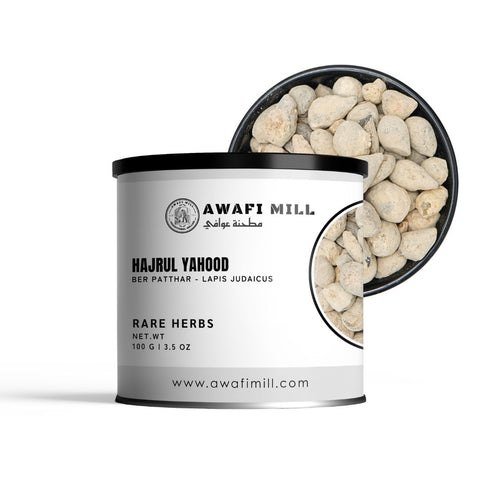
-
Also known as: Ber Patthar, Stone of Judea, Jew’s Stone, Hajar-ul-Yahud, Fossil Sea Urchin Spine.
-
Scientific name: Lapis Judaicus (The fossilized spines of the ancient sea urchin Cidaris glandifera).
-
The Geological Heritage: This is not a common river stone. It is a biological fossil dating back millions of years. Found primarily in the limestone strata of the Middle East, these "stones" are the mineralized remains of prehistoric marine life, shaped like small olives or acorns with distinct longitudinal striations.
-
Physical Characteristics: Small, ovate, and stony. They are typically earthy-grey to light brown in color. When handled, they feel surprisingly dense and cool, possessing a fine-grained, calcified texture that is characteristic of ancient marine fossils.
-
Chemical Profile: Composed almost entirely of Calcium Carbonate ($CaCO_3$), integrated with trace amounts of magnesium, silicates, and other seafloor minerals concentrated over eons of fossilization.
-
Historical Context: In the classical world of Dioscorides and the medieval scholars of the Unani and Arabic traditions, Hajrul Yahood was a prestigious mineral staple. It was traditionally gathered from the mountains of Judea and Syria and traded along the Silk Road as a "Lithic Marvel."
-
Traditional Preparation: For artisanal use, the stone is often subjected to a process called "Kushta" or "Bhasma"—where it is purified and ground with rosewater or herbal decoctions into an ultra-fine, velvety powder.